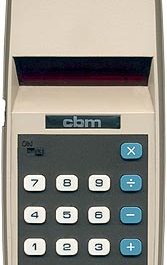
The Commodore US-10 calculator, manufactured in the USA in 1973, is a robust and functional calculator designed for everyday use. With its chunky design and bright orange Panaplex display, it stands out among calculators of its era. The calculator is powered by mains electricity (230V 50-60Hz) through a permanently fixed, two-wire cable, which enters the calculator on the far right of the top edge. The on/off switch is conveniently located on the front, at the top right.

The Commodore US-10 features a 10+1 digit display, with the eleventh digit used for input overflow, negative, and error indications. It offers standard four functions with switched constant, floating, and 4/3/2 fixed decimal modes. The calculator operates on semi-RPN (Reverse Polish Notation) logic, which might take some getting used to for those unfamiliar with this system.

The calculator’s case is made from two sections of matt black plastic, with cooling grills in the area of the on/switch at the top of the front. An orange plastic display filter sits tilted and inset in its own escutcheon, and above the display is a recessed area with a plastic logo label featuring raised and silver-painted lettering. The rear of the calculator has a metal “U” shaped leg that can be hinged out to increase the angle at which the calculator sits.
The keys and switches on the Commodore US-10 are big and chunky, with long travel and a hollow, loud clunk and bounce. The color scheme of white, blue, and red is simple and not too cluttered. The constant key “K” is a push-on/push-off switch, and a slide switch selects between floating decimal and 2/3/4 fixed decimal points.

Disassembling the calculator is straightforward. From underneath, remove the four screws (two large, two small) and the base section will lift off easily. The main CPU board (US 10 300027 H MCL-45F) faces down in the calculator front and doubles as the keyboard assembly. It is held to the front section with numerous screws, some in pillars and some in metal brackets. These screws usually have tamper-evident resin.
The calculator’s components include a CPU (TMS0175C 7337), an 11-digit Panaplex unit, and a large quantity of transistors, diodes, capacitors, resistors, and a transformer.

Logic:
- (CE) is used once to cancel the last number entered and (C) to clear the whole calculator.
- Input overflow is not suppressed; keying an eleventh digit creates an error state with “C” in the far left (ninth) digit and is not recoverable.
- The logic is semi-reverse Polish Notation (RPN): to do 5-8 key in (C)(5)(+=)(8)(-=) to give “-3”.
- There is switched automatic constant using (K) on multiply and divide only.
- Negative numbers are shown with a minus in the far left (ninth) digit thereby allowing full ten digit negative numbers.
- Divide by zero shows zero and an upper “n” in the far left (ninth) digit and is not recoverable.
- Overflow shows the result shifted and an upper “n” (or upper square box if negative) in the far left (ninth) digit and is not recoverable.
- A slide switch selects between floating decimal and 2/3/4 fixed decimal points.
- No known bugs.

The Commodore US-10 calculator is a reliable device with a reasonable logic system, though it lacks recovery features, especially on input overflow. Its design is sturdy, and the display is bright, making it a practical choice for basic calculations and an interesting item for collectors.