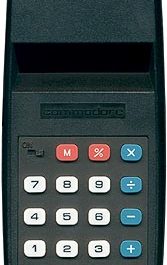
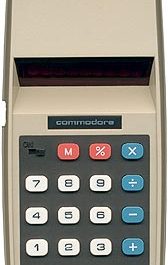
The Commodore SR8120, released in 1976, is a compact scientific calculator from Commodore Business Machines Inc., part of their “7 and 8” series that included models with 9 or 14 digits. It was also known as the SR8120D. Measuring approximately 75mm wide, 145mm tall, and 24mm deep, it weighs 114g without batteries. Power is supplied by a single 9V PP3 battery, though it also supports an external adapter via a socket on the top right. The manual advises removing the battery when using the adapter.

Housed in a two-piece matte plastic case with dark brown and beige coloring, the keyboard surround is matte black, while the panel beneath the display features rough black plastic. A recessed metallic brand sticker sits on the top. The keyboard uses Commodore’s typical color scheme, with small, “squishy” keys that remain functional. Additional functions are labeled in green on raised key surfaces. The display is a 12-digit red LED with a bubble lens and a full-length magnifying lens. Three digits on the far right are slightly smaller, and the twelfth digit serves as an indicator for negatives or errors. Though clear and large, the display has a limited viewing angle due to its heavily inset red plastic filter.

Functionality includes standard arithmetic, logarithms, trigonometry, nth roots, powers, pi, sign changes, and degree/radian conversion. It offers a double two-function memory system. Scientific mode uses an 8-digit mantissa and two smaller exponent digits. Internal precision is ten digits, though this drops for powers (nine digits) and trigonometric functions (eight digits, except for tangent above 89°, which reduces to six).

Internally, the calculator features a Commodore GHU-03A 7549 CPU and supporting ICs, including a GHU-01A 7545 and two ITT 546A-5N 7531 display drivers. The main CPU board rests above the keyboard assembly, connected via a 21-way ribbon cable. Disassembly involves removing two screws from the back and gently releasing inner lugs visible through the battery compartment.

Logic
- The (C) key acts as (CE/C): first press cancels the last entry, second clears entirely.
- No constant function exists for repeated operations.
- Scientific mode uses 8+2 digit formatting (mantissa + exponent).
- Input overflow is suppressed; a ninth digit entry is ignored.
- Negative numbers display a “-” in the twelfth digit.
- Overflow, underflow, or division by zero triggers an unrecoverable “E” in the twelfth digit.
- The (+/-) key works mid-entry but not before input begins.
- (F) activates higher functions via a two-key sequence; it does not self-cancel.
- Two memories allow store (STO1) and recall (RCL1), with overflow blocked unless manipulated by division.
- Memory status is shown via the ninth digit’s decimal point.
- (MR) recalls memory; (MT) recalls and clears it.
- Powers and roots use logarithmic calculations; negative bases are unsupported.
- (d-r) switches degrees/radians, converting displayed numbers instantly. Radians mode lights the first digit’s decimal point.

While the SR8120’s logic is precise and largely reliable, its limitations include no recovery from errors, basic memory functions, and restricted power/root operations. The absence of a constant function and the need to manually cancel shift modes add friction. Its design reflects mid-1970s engineering—practical but constrained by the era’s technical boundaries. The calculator remains a functional example of Commodore’s early foray into scientific tools, balancing clarity and utility with some operational quirks.