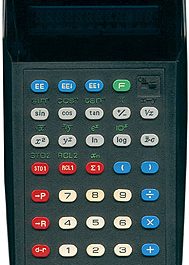
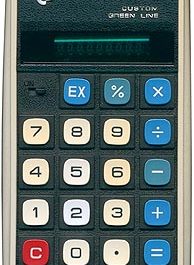
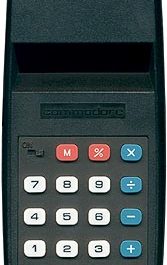
The Commodore SR9120D calculator, introduced in 1975, is a product of Commodore Japan Limited. This calculator offers a blend of functionality and style that sets it apart from other models of its time.
Measuring approximately 75mm x 140mm x 30mm (width, height, depth) and weighing 130g (excluding batteries), the SR9120D is compact and portable. It is powered by a 9.0V DC battery (PP3 size) and can also accept an adapter/charger (DC640, 7070, or 709) through a socket on the right-hand side.

The calculator’s case design is notable for its two-piece construction in matt and smooth black plastic, featuring sculptured edges. The Commodore (or CBM) logo is elegantly displayed on a reversed-out printed metal plate in a recess. The keys are brightly colored, squishy yet responsive, although the additional key labelling, which is raised and printed in green, does not usually age well.
The SR9120D features a 10+2 red LED display with a single linear lens. This display includes a third and fourteenth digit for negative sign and error indication. The calculator offers standard four functions along with change sign, pi, register exchange, reciprocal, square root, nth root, squares, powers, logs, trigs, standard deviations, degree/radian, polar-rectangle coordinates, twin memory, parenthesis, and exponents.

Inside, the calculator is equipped with a Commodore GHU-02A 7531 CPU (40 pin DIL), a Commodore GHU-01A ESR N 7531 IC (8 pin DIL), ITT 546A-5N display driver ICs (16 pin DIL), a 14-digit LED display module, a capacitor, and a resistor. The keyboard board is attached to the front, while the main CPU board sits loosely on top, connected via a 21-way ribbon cable.
Disassembly of the SR9120D is straightforward: remove the two screws at the bottom rear of the case and gently squeeze in the front piece to lift off the back.

Logic
- The (C) key operates as a cancel entry function on the first press while a second press will clear the calculator.
- Input overflow is suppressed, inputting an eleventh digit is ignored.
- Negative numbers are shown with a “-” in the far left (fourteenth) digit thereby allowing full ten digit negative numbers. Negative exponents are shown with a “-” in the third digit.
- There is no constant function.
- Divide by zero shows “E” in the fourteenth digit and is not recoverable.
- Overflow shows “E” in the fourteenth digit and is not recoverable.
- There is no indication of memory – you have to remember it.
The Commodore SR9120D is a versatile calculator with 39 keys and a range of useful functions. It features a nice flat LED display, although it lacks error recovery capabilities. The model number’s “12” refers to the number of digits, with 9 and 14-digit versions also available. The original case is shaped soft black plastic with a popper closing at the top, embossed with the Commodore logo on the front and “Made in Japan” on the back.

The Commodore SR9120D is to be a functional and stylish calculator for its time, offering a range of useful mathematical features. Its design is notable for its aesthetics and portability, although the lack of error recovery and memory indication might be seen as limitations. Overall, it was a solid option for those needing a reliable calculator with a good set of functions.