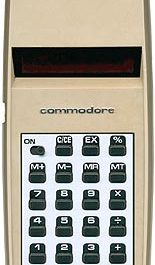
The Commodore SR4912 scientific calculator, released in 1978, represents an interesting piece of late 1970s ccalculator technology. Manufactured in Hong Kong, this handheld device packed considerable mathematical capabilities into a compact form factor measuring approximately 80mm x 147mm x 20-40mm and weighing just 124 grams without batteries.
The calculator’s physical design featured a two-piece black plastic case with silver printed trim, including a raised brand name. The keyboard layout utilized a mix of light and dark grey, white, and black keys surrounded by a black frame. While the keys employed a short-travel “squishy” mechanism, they provided reliable functionality. The display featured a deeply inset, tilted red filter that effectively enhanced the visibility of the LED output.

The SR4912’s display system consisted of 8+2 red LED digits with bubble lenses, plus an additional digit for negative numbers and error indicators. The display included an intervening digit for negative exponents, maintaining consistent digit size throughout. A power-saving feature automatically dimmed the display after approximately 60 seconds, leaving only a single decimal point visible.

Power came from a standard 9V PP3 battery, with the option to use an external power adapter (models DC-505, 707, 708, or 709) through a center-positive connector located at the top of the device. The internal construction was straightforward, featuring a single board that served as both the keyboard interface and CPU housing. This board, designated PCB No. 201478 Rev A, contained a MOS MPS 7561 processor (manufactured in week 34 of 1978) and the LED display module.

The calculator offered a comprehensive set of mathematical functions, including basic arithmetic, percentages, bracketed operations, trigonometry, statistics, and polar coordinate calculations. It supported degree, radian, and gradian angle measurements, with mode indicators shown via decimal points. The memory system provided nine storage registers with five functions, though it lacked a visible memory indicator.

Logic:
- C/CE key cleared the last number on first press, full calculator on second press
- No constant function available
- Ninth digit input was suppressed during number entry
- Negative numbers displayed with “-” in far left (ninth) digit
- Division by zero showed “E” in eighth digit with no recovery option
- Overflow conditions displayed “E” in left (eighth) digit, unrecoverable
- Negative square roots produced “E” in left (eighth) digit, unrecoverable
- Change sign function worked during number entry
- Memory operations required two-key sequences (e.g., STO 4, RCL 4)
- Memory corruption possible when storing error states
- Power save activated after 60 seconds, showing single decimal point
- Function key (F) accessed operations printed above regular keys
- XCH key exchanged memory registers, X<>Y exchanged calculator registers
- Gradian mode indicated by far left (ninth) digit decimal point
- Radian mode shown by far right (first exponent) decimal point

The SR4912 demonstrated Commodore’s practical approach to scientific calculator design, offering substantial computational power despite some operational quirks. The “SR” designation stood for “Slide Rule,” reflecting its scientific capabilities, while the model number likely referenced its 49 keys and 12-digit display capacity. Though lacking certain features like constants and error recovery, the device’s quality construction and full function set made it a capable tool for scientific calculations.